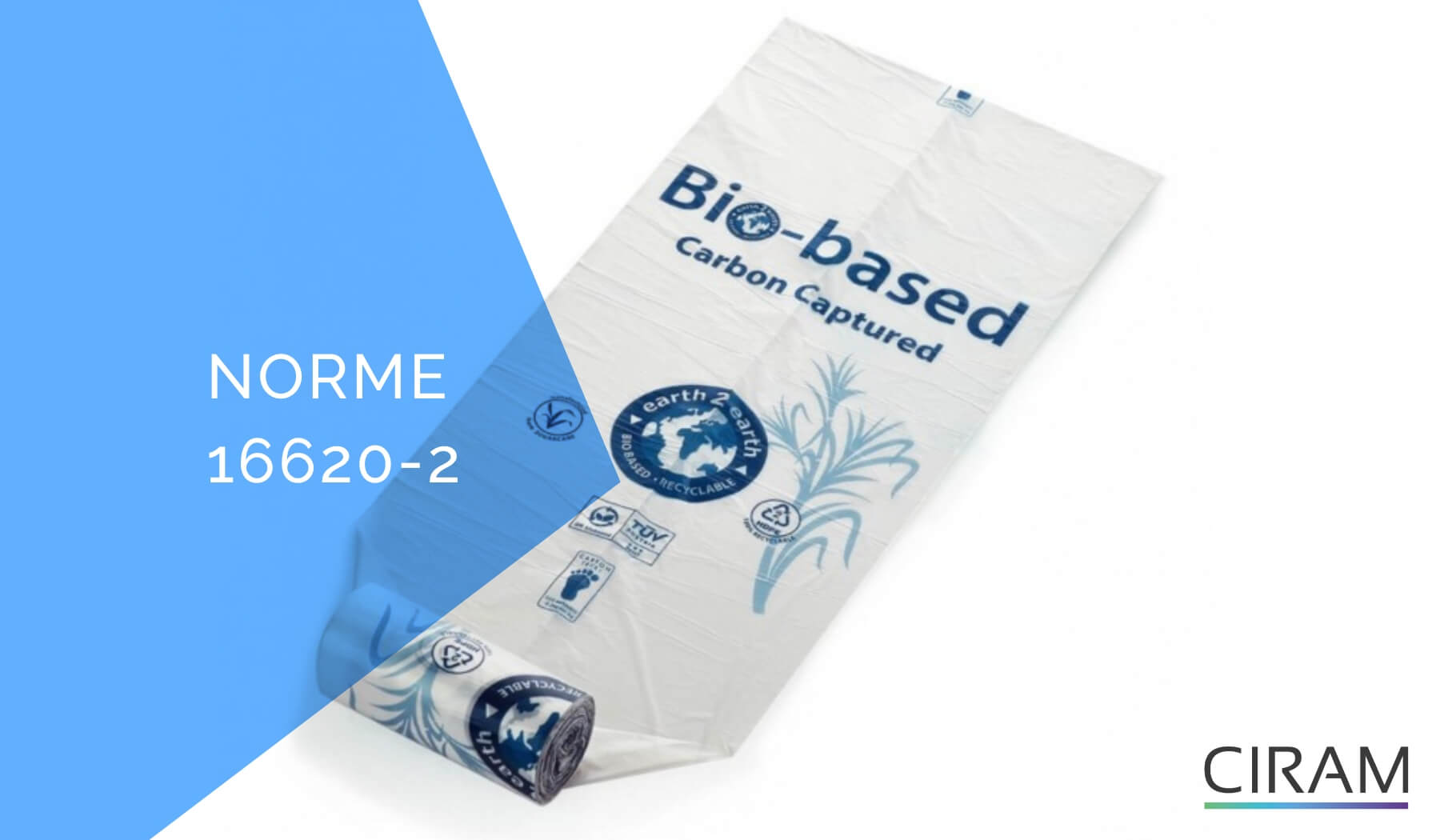

In modern industry, sustainability and regulatory compliance are major issues for manufacturers, particularly in the plastics and polymers sector. The ISO 16620-2 standard, which is based on the Carbon 14 method, allows for precise measurement of the carbon content biobased in these materials.
In this article, we explore how the ISO 16620-2 standard, based on the Carbon 14 method, allows for the qualification and quantification of the biobased and petro-sourced parts of polymers in general, and plastics in particular. You will also discover the importance of analysis laboratories like CIRAM, which support manufacturers in applying this standard to ensure the quality control and conformity of their materials.
Understanding ISO 16620-2 and its importance for industry
The ISO 16620-2 standard is essential for manufacturers wishing to measure the biobased carbon content of plastics to ensure their compliance and sustainability. This standard makes it possible to precisely identify the proportion of renewable carbon through radiocarbon dating analysis.
What is ISO 16620-2?
The ISO 16620-2 standard establishes a protocol for measuring the biobased carbon content of plastics and biopolymers using Carbon 14 analysis. It distinguishes between modern carbon (containing 14C, found in biomass) and fossil carbon (without 14C, as in petroleum). This process allows for the precise quantification of the biobased portion.
Beyond voluntary declarations by mass balance and/or life cycle analysis and/or the ISCC method, it is essential to use objective, reliable, and rapid measurements to qualify and quantify the share biobased of biopolymers. The percentage of modern carbon (pMC) relative to total carbon is calculated according to this standard, guaranteeing a reliable measurement respected by certification bodies such as TÜV AUSTRIA and DIN CERTCO. The standard also specifies the reference values: 100 pMC since 2019 for carbon biobased at 100%.
Why is this standard crucial for manufacturers?
Analyses conforming to ISO 16620-2 allow industry professionals to certify the renewable carbon content in their products. This material certification step biobased is crucial as it validates product compliance within the framework of current regulations and environmental certifications.
Since 2020, for example, European legislation has required plastic bags to contain at least 50% biobased carbon, with this threshold rising to 60% by 2025. Carrying out this type of analysis is a key differentiating factor for companies wishing to meet new standards and requirements in the plastics industry.
Application of ISO 16620-2 for the analysis and certification of bioplastics
The application of the ISO 16620-2 standard allows manufacturers to reliably quantify the share biobased in plastics. This step is essential for obtaining certifications and ensuring the conformity of the materials used.
Radiocarbon analysis of plastics: the Carbon-14 method
The Carbon-14 method is used to distinguish fossil carbon from biobased carbon in polymers. This analysis is based on measuring the isotopic ratios of 14C, 13C, and 12C, and allows for the calculation of the percentage of modern carbon.
To comply with ISO 16620-2, radiocarbon measurement must be expressed as a percentage of modern carbon, or pMC. The biobased carbon content can then be expressed as a percentage of total carbon, TC, or as a percentage of total organic carbon, TOC.
ISO 16620-2 also sets a reference value, REF, for 100% biobased carbon content.
According to ISO 16620-2, this REF is or was :
- to 100 pMC from 2019, for 100% biobased carbon content.
- to 102 pMC in 2015, for a 100% biobased carbon content.
- 200 in 1964-1965, for a 100% biobased carbon content.
Consequently, the biobased carbon content of a material is the value of the measured pMC / REF.
ISO 16620-2 also allows for a variation of up to ±2% in biobased carbon content, depending on the Accelerator Mass Spectrometry (AMS) used. Consequently, a measurement of 98 pMC can be considered to correspond to 100% biobased carbon in relation to total carbon.
Certification and quantification of biomass in plastics
The ISO 16620-2 standard is crucial for certifications such as OK Biobased® or DIN CERTCO®, which require radiocarbon analyses to validate the proportion of biopolymers in a product. The EN 16620-2 standard clearly indicates the information to be reported in analysis reports. In addition to the measurement of pMC, we must indicate:
- χTC the total carbon content of the sample,
- χB the biobased carbon content as a fraction of the sample mass
From the reference value REF, χTCB, which is the carbon content biobased relative to the total carbon content, can be calculated. It is this value that is decisive.
Using this standard, manufacturers can not only quantify their biomass content, but also ensure the certification of biobased materials at every stage of the industrial process, from R&D to marketing.
The role of laboratories in implementing ISO 16620-2
Specialized laboratories like CIRAM play an essential role in implementing ISO 16620-2, guaranteeing accurate and reliable analyses for industry professionals.
Importance of analytical laboratories in the plastics industry
Analytical product laboratories biobased such as CIRAM play an essential role in the application of the ISO 16620-2 standard. They provide precise services to verify carbon content biobased at each stage of the industrial process, whether for raw materials, products in progress, or finished products. The Carbon 14 method, used in these laboratories, allows for the certification of materials while adhering to the strict requirements of certification bodies and international standards. Specialists in Carbon 14 by AMS since 2005, our laboratories, in addition to complying with current international standards, deliver accurate and reliable results thanks to innovative solutions and personalized support.
For industry professionals, this means being able to rely on reliable results to validate material conformity, ensure rigorous quality control, and guarantee that their products comply with current standards, notably those required for certification of biobased materials.
Quality control and ISO compliance in the bioplastics industry
Quality control is a priority in the bioplastics industry, where the integration of standards such as ISO 16620-2 is becoming essential to prove product sustainability. Thanks to ISO 16620-2-compliant analyses, manufacturers can control the quality of bioplastics and guarantee that their products meet biomass and biobased carbon content criteria.
Coupled with complementary standards like ASTM D6866 analysis, this approach guarantees compliance with ISO 16620-2, which is essential for companies' competitiveness in a sector undergoing rapid transformation towards more responsible materials. Specialized industrial laboratoriesbiobased like CIRAM thus enable companies to secure their production chain while meeting regulatory and environmental expectations.
The ISO 16620-2 standard is a key tool for the plastics industry biobased, ensuring material compliance and certification. Through rigorous methods like Carbon 14 analysis, it allows manufacturers to accurately quantify the renewable carbon content in their products. Specialized laboratories like CIRAM play a crucial role in this process, offering reliable analyses and personalized support. To learn more, contact the CIRAM teams and request your sample study.